

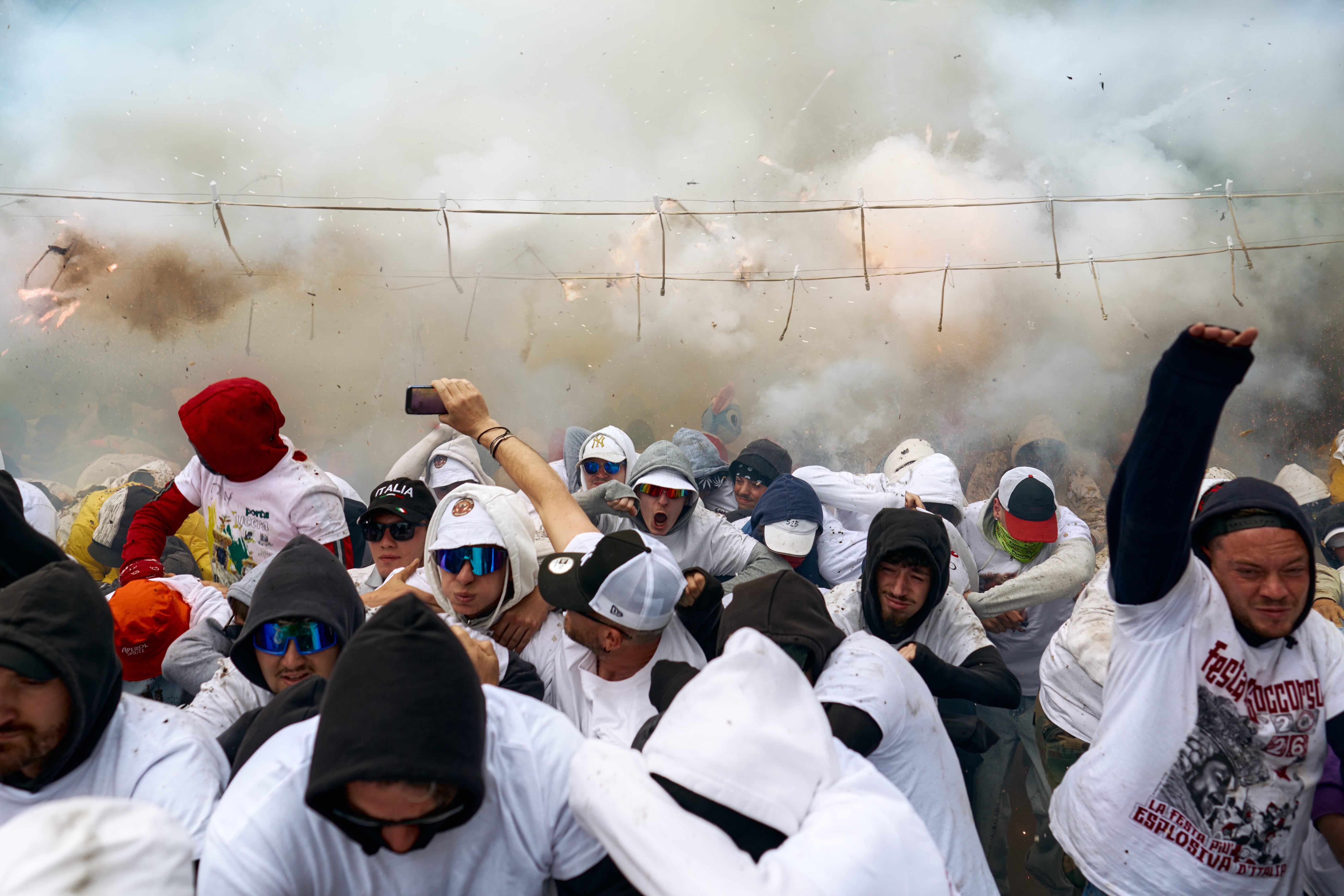
A crowd surges beneath a tunnel of firecrackers suspended above our heads. The sky disappears, swallowed by a curtain of smoke and explosions. My instinct as a photographer is to plant my feet and hold my ground, hoping the human avalanche will part around me, but it doesn’t. Hands pull at me, someone grabs my backpack and drags me away from the shot.
The smoke
La Festa del Soccorso takes place on the third weekend of May in San Severo, one of those provinces in southern Italy where the numbers tell a familiar story of exodus: one in four young people emigrates, fleeing violence and economic uncertainty. And yet they all return for this one day. No self-respecting sanseverese would miss it. One of them told me he had notified his boss like this: “Your choice, holiday or sick leave.” That was all the negotiation required.
They had welcomed us with enthusiasm. I caught up with my childhood friend Stefano, who would guide us through the festa with the access of invited guests. A local newspaper gave us a tour of the churches and arranged for us to appear on their pages as visiting journalists. We thought it was going to be a comfortable little mission.
However, my attempts on Friday and Saturday to photograph the fujenti, the mass of believers running beneath the fireworks, were disasters. Their force threw me off, literally, while focusing on protecting my gear with my body. A guy that was also runing from the fireworks shouted at me, concernedly: “Watch out, you’ll break it like that!”.
The spark
At the center of the chaos and the fire in the streets is the Black Madonna. I understood the gravity of her pull on Sunday, watching the drawing of lots for her bearers inside the sanctuary. The most coveted positions are at the exit from the cathedral and the return. I was standing next to a man at the exact moment his name was drawn. I watched him run to tell a relative, his eyes glistening. He caught my gaze and, as if to justify himself, exclaimed: “It’s an immense emotion.”
Some hours later, while waiting in the town square for the Madonna del Soccorso to emerge from the cathedral, a young man came up beside me, held out his phone, and asked with quiet pride: “Have you seen how beautiful our Madonna is?”
I found Stefano in the crowd, hollowed out from having stayed up all night enjoying the party, and yet there he was, still awake at the church first thing in the morning. Around him, to my surprise, were many young men and women. I had grown up in Manfredonia, just a few kilometers away, where processions are an affair for the elderly, a tradition that frays with each generational shift. Not here. These young people waited for the statue with an intensity I hadn’t expected.
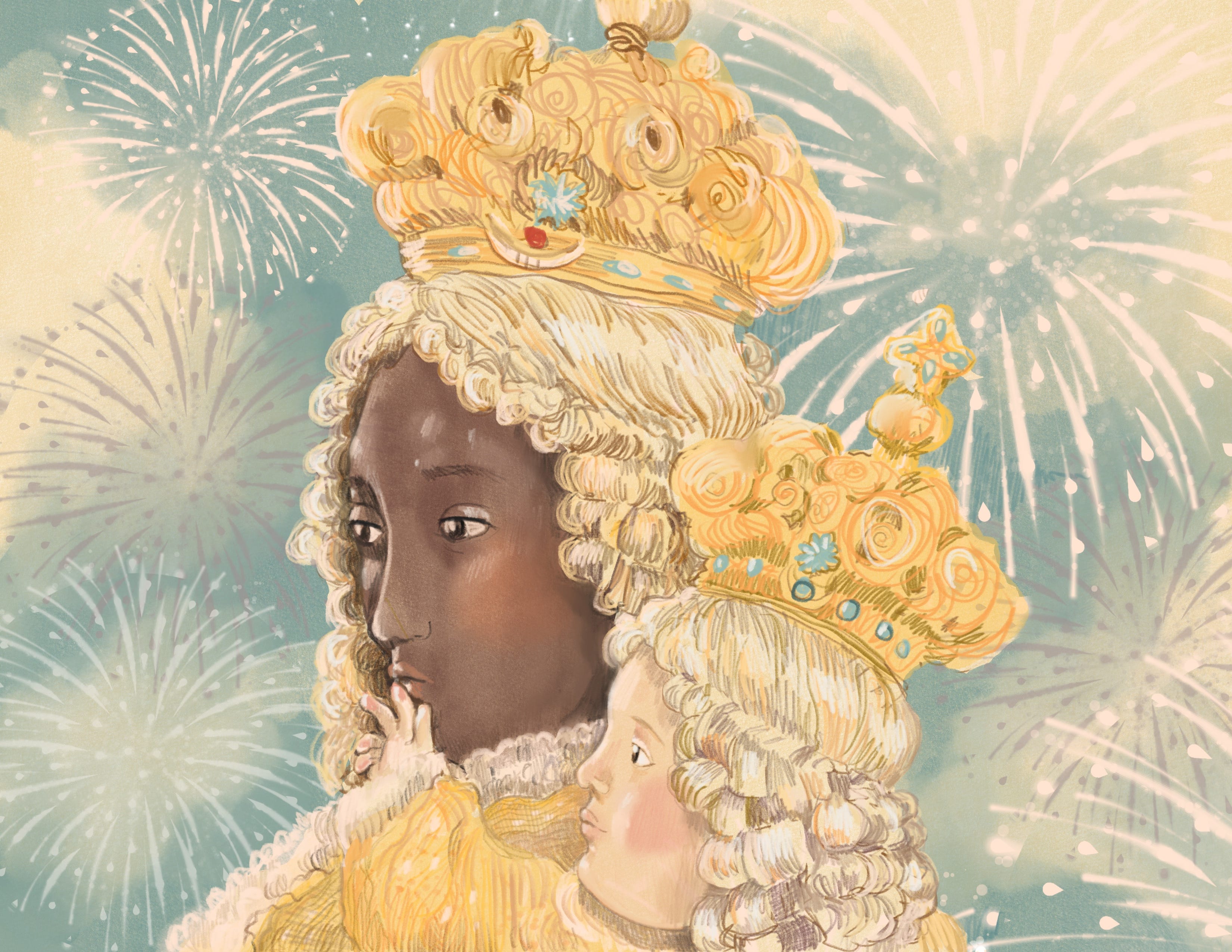
The Madonna finally emerged, borne on a gilded wooden fercolo dating to 1879, lifted on the shoulders of the lucky bearers. They advanced with the nazzicata, a rhythmic sway meant to soften the rigidity of the heavy platform, cradling the figure as she moved through the crowd. La Madonna Nera carried an olive branch in one hand and a blond Christ child in the other. Her dark face, framed by a crown and golden curls, looked straight ahead down the street. The square erupted in applause, confetti, and the cry of “Viva Maria!”
Determined not to repeat my previous experience, on Sunday morning, I followed Stefano’s advice to film from the back of the crowd. The photos were clean but not revelatory. I was relegated to the margins alongside the people recording on their smartphones. To get something real, I needed to be among the fujenti.
On Monday, my last day, Stefano listened to my grievances and introduced me to “the tough ones”: a group of veteran fujenti wearing the same flag and the same hat. I explained my problem to them: I wanted to get inside the fire, but have some protection to ensure at least a good photo.
They said, almost in unison: “We’ll form a block.”
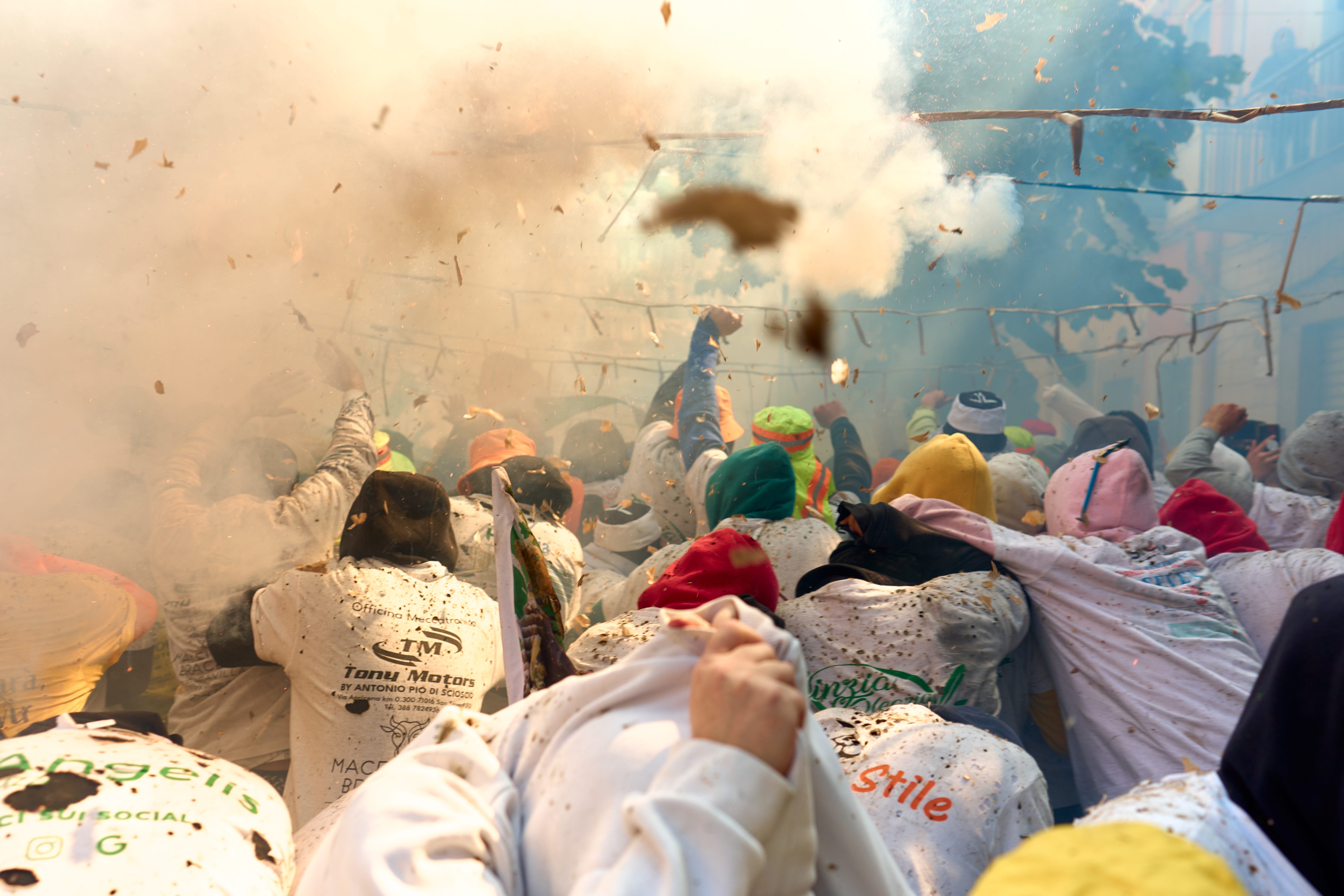
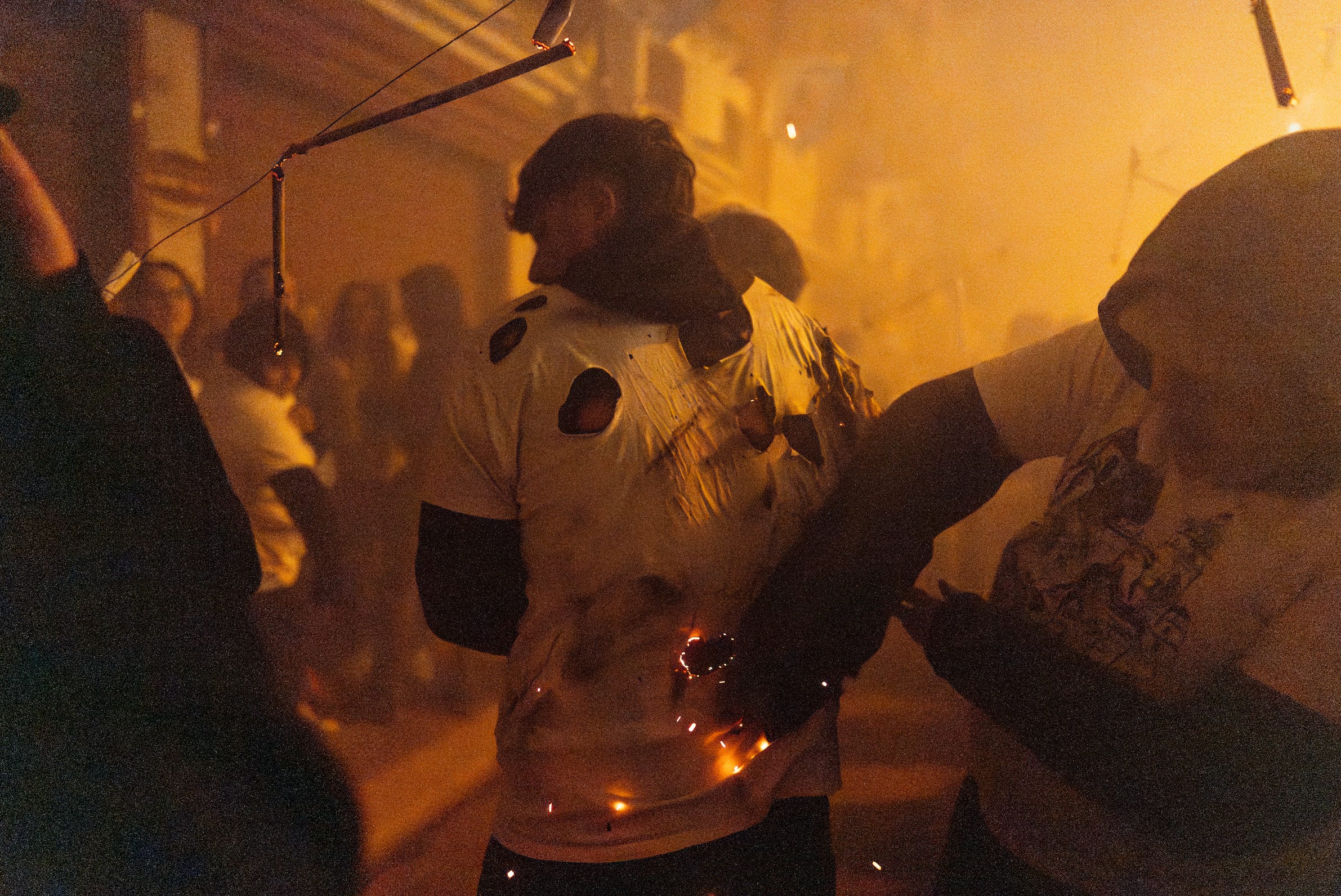
They explained the formation: four in the front, four behind, me in the middle. We took our positions on the starting line. When the first bang arrived, I felt a rush of adrenaline. The herd crashed into us, but the human shield held. Above us, hell broke loose. Sparks rained down on my arms. The crowd crushed us against a central post and my leg got swallowed, my shoe tore off. I found myself running barefoot on asphalt scorched with sparks.
“Go on, don’t worry!” the veterans shouted above the colective roar. “The block’s holding!”
It was an eternity that lasted two minutes. When we came out the other side, my sock was charred and I had a few mild burns on my skin, but I had shot the fire from the inside. Around me, my team of protectors cheered. They had joined together to help a stranger, and in doing so let me experience their fierce closeness firsthand.
I had only lost a shoe.
The fire
After our victory, we arrived at the church thirty, maybe forty minutes before the Madonna’s return. The fujenti pushed the crowd aside to secure their entry, while those at the doorway pushed back: “There’s no room for everyone.” Between one shove and the next, I was sucked inside.
Inside the church, the previously festive locals fell silent. Men removed their hats and sunglasses. Gazes dropped to the floor, expressions full of guilt, or reverence, something between the two. The young men I had been joking with in the street barely looked at me. They were focused on something else.
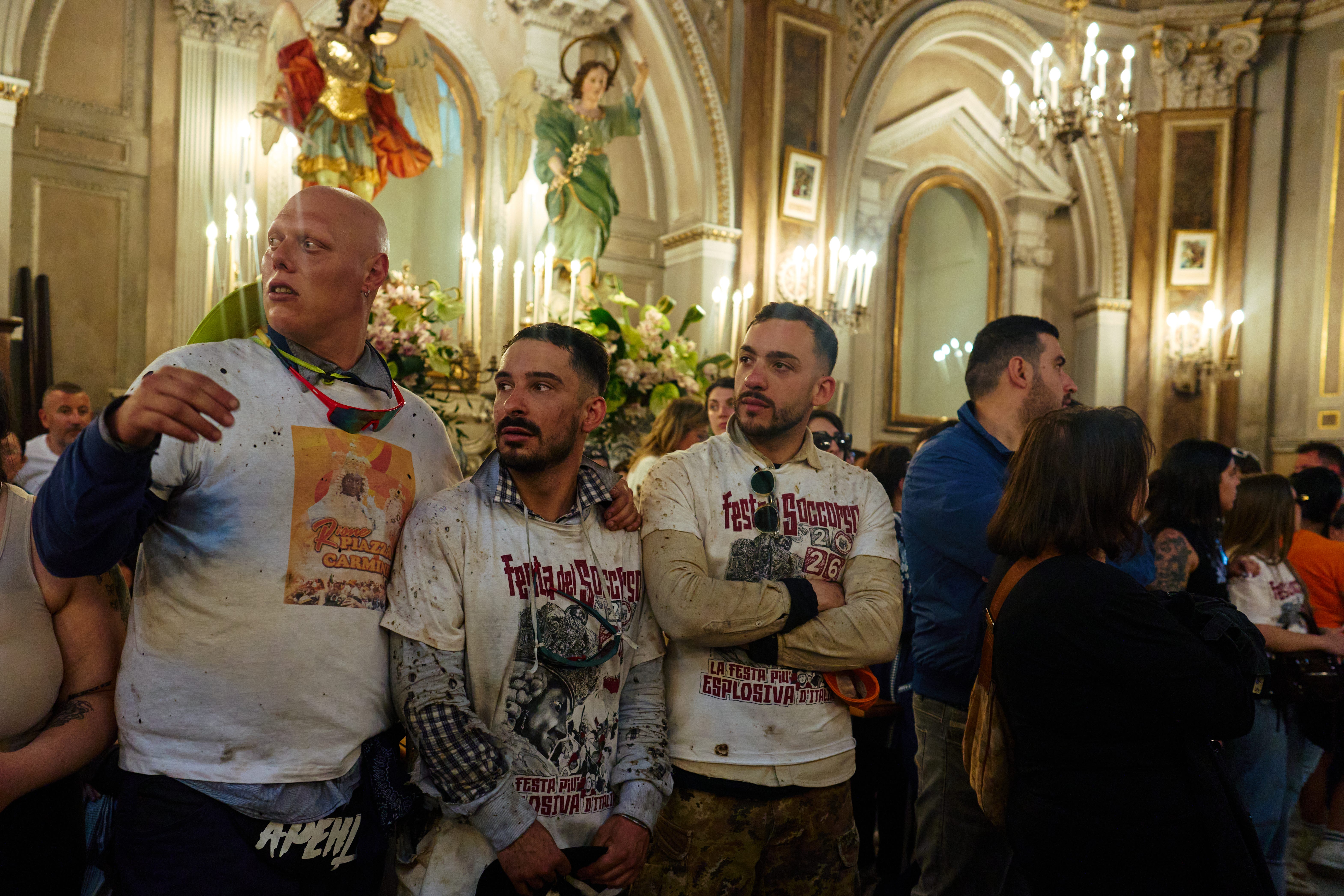
Near the exit, a fujente pleaded with the man guarding the doors to let his cousin in. He explained that he was going through a terrible time with his wife: “he deserves to be inside, he deserves to see Maria.” No use. The doors were sealed. When the statue entered surrounded by applause and confetti, the same fujente broke down in tears. Another man nudged my arm: “Get some photos of Maria, she’s beautiful.”
While crossing the nave, the procession was forced to stop. One of the bearers broke into uncontrollable sobbing; he could no longer carry the weight. Others rushed to support him, and I noticed that they were crying too.
I looked at the crowd: no one was holding back anymore. The man who stepped forward to replace the bearer hid his tears behind his sunglasses. They set the Madonna in the center of the church. The atmosphere was like a stadium, chants, applause, and prayers shouted at the top of their lungs.
The following day, I described the scene to Stefano over the phone.
“That’s where you can really see how much this city is suffering,” he said.
In the center of an explosive party there was a desperate call for unison. A way of holding onto each other, at least once a year, as part of something much greater.
Written by Ana Ben, based on the coverage and photography of Daniele Colucci for www.sacratos.com